
在凸四边形 $A B C D$ 中,$A B=B C =C D=2 A D=2$,则 $\overrightarrow{A B} \cdot \overrightarrow{D C}$ 的最大值为_____.
答案 $\dfrac 72$.
解析 题意即 $\overrightarrow{AB},\overrightarrow{DC}$ 的模均为 $2$,起点的距离为 $1$,终点的距离为 $2$,求数量积的最大值.
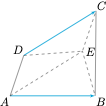
不妨设 $\angle DAB\leqslant \angle ADC$,将 $\overrightarrow{DC}$ 平移到 $\overrightarrow{AE}$,则 $AE=DC=2$,$CE=AD=1$,此时\[\overrightarrow{AB}\cdot \overrightarrow{DC}=\overrightarrow{AB}\cdot \overrightarrow {AE}=\dfrac 12(AB^2+AE^2-BE^2)=\dfrac 12(8-BE^2)\leqslant \dfrac 72,\]等号当 $E$ 在线段 $BC$ 上时取得,因此最大值 $^{[1]}$ 为 $\dfrac 72$.
另法 可以看到 $\overrightarrow{AB}\cdot \overrightarrow{DC}$ 只与 $\overrightarrow{AD},\overrightarrow{BC}$ 的夹角 $\theta$ 有关,因此\[2\overrightarrow{AB}\cdot \overrightarrow{DC}=AB^2+DC^2-\left(\overrightarrow{AB}-\overrightarrow{DC}\right)^2=AB^2+DC^2-\left(\overrightarrow{AD}-\overrightarrow{BC}\right)^2=3+4\cos\theta\leqslant 7,\]以下略.
备注 接来下考虑取值范围 $^{[1]}$,以 $BC$ 中点 $M$ 为原点建立平面直角坐标系 $M-Cy$,设 $B(-1,0),C(1,0),A(-1+2\cos\alpha,2\sin\alpha),D(1+2\cos\beta,2\sin\beta)$,其中 $\alpha,\beta\in (0,\pi)$,则\[AD=1\iff (-2+2\cos\alpha-2\cos\beta)^2+(2\sin\alpha-2\sin\beta)^2=1,\]整理得\[\cos(\alpha-\beta)+\cos\alpha-\cos\beta=\dfrac{11}8,\]此时\[\overrightarrow{AB}\cdot\overrightarrow{DC}=(2\cos\alpha,2\sin\alpha)\cdot (-2\cos\beta,-2\sin\beta)=4\cos(\alpha-\beta),\]设 $\theta=\alpha-\beta$,则有\[2\sin\dfrac{\alpha+\beta}2\sin\dfrac{\theta}2=\dfrac{11}8-\cos\theta\implies \sin\dfrac{\alpha+\beta}2=\dfrac{\frac{11}8-\cos\theta}{2\sin\frac{\theta}2},\]而凸四边形条件即($\times$ 表示向量叉积)\[\begin{cases} \overrightarrow{AD}\times \overrightarrow{AB}>0,\\ \overrightarrow{DC}\times\overrightarrow{DA}>0,\end{cases}\iff \begin{cases} \sin\alpha+\sin(\alpha-\beta)>0,\\ \sin\beta-\sin(\alpha-\beta)>0,\end{cases}\iff \begin{cases} \sin\alpha>\sin\theta,\\ \sin\beta>\sin\theta,\end{cases}\]于是 $\alpha>\theta$ 且 $\alpha+2\theta<\pi$,于是\[\dfrac{3\theta}2<\dfrac{\alpha+\beta}2=\alpha+\dfrac{\theta}2<\pi-\dfrac{3\theta}2\implies \sin\dfrac{\alpha+\beta}2>\sin\dfrac{3\theta}2,\]于是\[1\geqslant\dfrac{11-\cos\theta}{2\sin\frac{\theta}2}>\sin\dfrac{3\theta}2\iff 1\geqslant \dfrac{\frac 38+2x^2}{2x}>3x-4x^3\iff \dfrac{1}{16}\leqslant x^2<\frac 18,\]其中 $x=\sin\frac{\theta}2$,因此\[\overrightarrow{AB}\cdot \overrightarrow{DC}=4\cos\theta=4(1-2x^2),\]取值范围是 $\left(3,\dfrac 72\right]$. $ [1] $ 考虑 $ \angle BAE $ 的最大值(上确界),连接 $ AC $ 并设 $ AC=4x $,其中 $ \sqrt 6\leqslant 4x<3$,则\[\angle BAE=\angle BAC-\angle EAC=\arccos x-\arccos\dfrac{16x^2+3}{16x}=\arccos x-\arccos\left( x+\dfrac3{16x}\right),\]利用该函数的单调性可得.